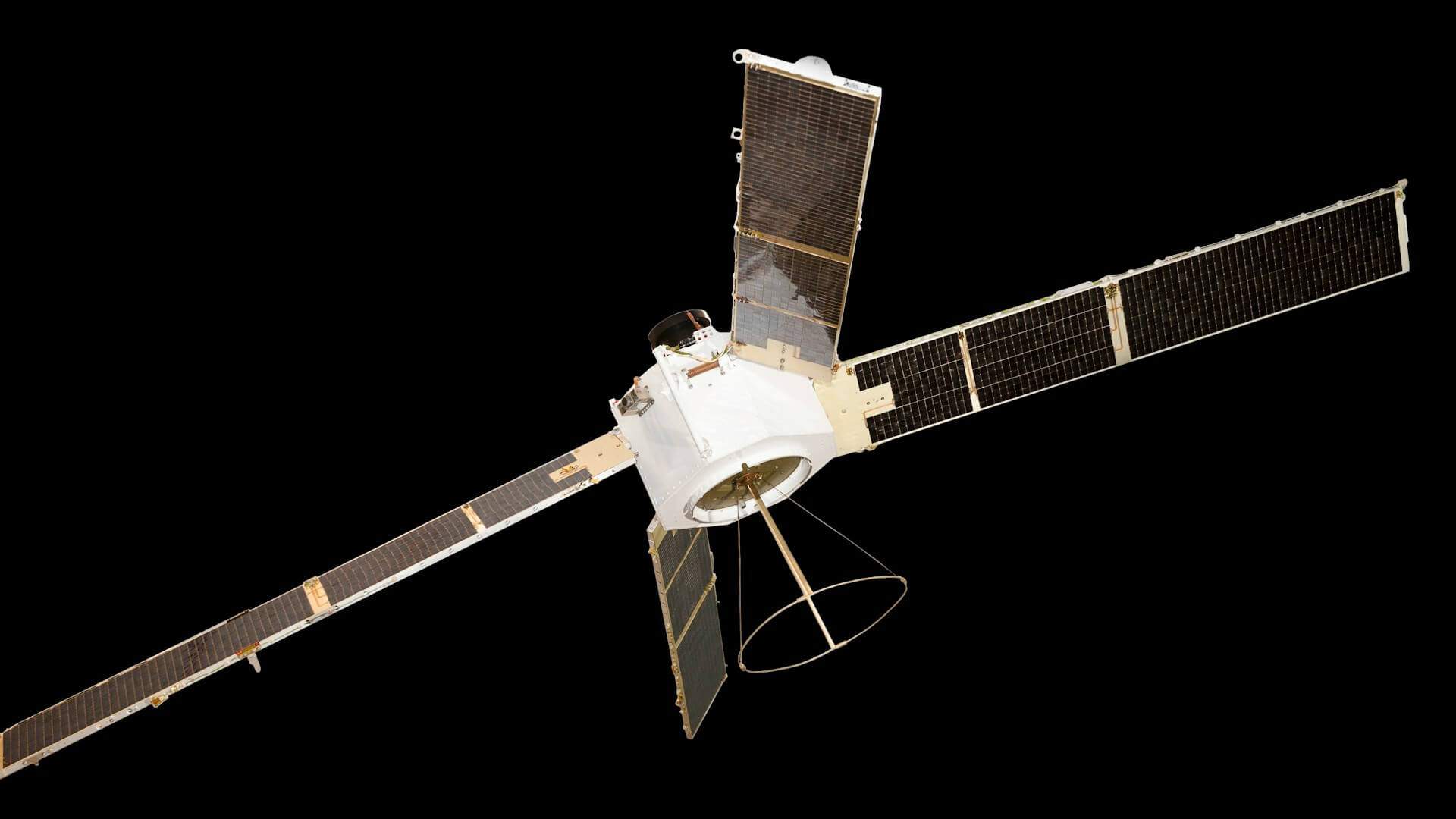
For most of the past forty years, the U.S. military space industrial base was structured like a luxury watchmaker: small batches, high margins, multi-year lead times, and a handful of artisanal suppliers per critical subsystem. That model produced extraordinary spacecraft — GPS III, AEHF, SBIRS — and it produced them at a pace that worked for a peacetime constellation strategy. The Space Development Agency's Proliferated Warfighter Space Architecture changes the assignment entirely. The PWSA calls for more than 1,000 satellites in low Earth orbit by 2028 across the Tracking, Transport, Battle Management, and Custody layers. That is a tenfold increase over historic U.S. military spacecraft throughput, executed in less than five years, on a fixed budget.
The space industrial base is being asked to transition from boutique to backbone. The transition is uneven, painful, and — so far — incomplete. Every link in the chain, from bus production to optical inter-satellite links to xenon propellant, is being stress-tested by demand it was not built for.
The PWSA Architecture and Its Throughput Demand
SDA's Tranche 1 Tracking Layer (28 missile-warning satellites) launched through 2025–2026. Tranche 1 Transport Layer (126 communications satellites) is mid-deployment. Tranche 2 Transport Layer (over 200 satellites) begins delivery in 2026, with Tranche 3 contracts awarded last year (Space Development Agency, 2025).
Combined with the National Reconnaissance Office's proliferated optical and radar constellations, U.S. Space Force and intelligence-community demand alone now exceeds 200 spacecraft per year — a number that would have been considered fantastical in 2019.
Where the Industrial Base Strains
Satellite Buses
The Tranche 1 Transport Layer bus production is shared across Lockheed Martin, Northrop Grumman, York Space Systems, and Terran Orbital. Tranche 2 added Sierra Space and Rocket Lab. The new entrants matter: small-bus producers like Apex Space and Loft Orbital have meaningfully expanded production rates by treating buses as standardized products with software-defined customization — closer to Tesla's manufacturing logic than to traditional defense spacecraft (Apex Space, 2025). Tranche 2 deliveries will reveal whether this scales.
Optical Inter-Satellite Links
Laser inter-satellite links are the backbone of the PWSA Transport Layer. The qualified supplier list is narrow: General Atomics, Mynaric, Tesat-Spacecom, CACI's photonics group, and Skyloom. Mynaric — a critical supplier — entered restructuring in 2024 under German insolvency proceedings, forcing emergency requalification of alternative optical terminals at SDA (SpaceNews, 2025). The OISL supply base is the single most fragile node in the Transport Layer architecture.
Radiation-Hardened Electronics
Rad-hard FPGAs, microcontrollers, and memory remain a U.S. industrial base concentrated in a handful of fabs: Microchip's Colorado Springs facility, BAE Systems' Manassas line, and Honeywell's radiation-hardened ASIC business. The 'rad-tolerant' commercial-off-the-shelf trend — using newer-node commercial silicon with shielding and software fault-tolerance — has expanded supply but has not eliminated the need for true rad-hard parts in deeper orbits and mission-critical control paths (NASA Goddard Radiation Effects, 2024).
Electric Propulsion Propellant
Xenon and krypton are the primary propellants for Hall-effect thrusters in LEO smallsats. Global xenon production is approximately 60 metric tons per year — and Starlink alone consumed roughly half of that in 2023–2024. Krypton substitutes have helped, but propulsion-grade xenon and krypton are now bottlenecking commercial and military programs simultaneously (Space Capital, 2025).
The Launch Cadence Question
Producing 200 satellites a year requires launching 200 satellites a year. SpaceX's Falcon 9 cadence — over 130 launches in 2024 — provides the foundation, but Space Force Vandenberg integration capacity, dedicated rideshare scheduling, and orbital plane selection are increasingly the binding constraints. United Launch Alliance's Vulcan, Blue Origin's New Glenn, and Rocket Lab's Neutron each add capacity that did not exist 18 months ago, but Space Force's National Security Space Launch certification queue has slowed integration (U.S. Space Force, 2025).
Resilience by Numbers: A Different Strategic Logic
Proliferated architectures change the resilience math. A constellation of 200 satellites tolerates the loss of a few; a constellation of 8 does not. SDA's premise — that proliferation buys deterrence at lower per-spacecraft cost — only works if the industrial base actually proliferates. Production stoppages at any one of the dozen primes feeding Tranche 2 cascade through the constellation's resilience profile within a single launch window.
What Tier-2 Space Suppliers Should Do Now
- Productize, do not customize: the customers that scale fastest treat the bus as a product. Custom payload integration is the value-add. Custom buses are a tax on cadence.
- Stand up genuine rate production lines: spacecraft AIT (Assembly, Integration, and Test) was historically a one-off process. PWSA demand requires takt-time production. Pratt & Whitney–style production logic now applies.
- Diversify launch-window assumptions: rideshare-dependent missions absorb the most schedule risk. Dedicated launches cost more but lock in delivery cadence.
- Engage with CMMC and security clearances early: SDA contracts now routinely require CMMC 2.0 Level 2, top-secret-cleared engineers, and DCSA-cleared facilities. Tier-2 suppliers without these credentials are out of contention.
Ground Stations: The Forgotten Backbone
Proliferated LEO architectures only deliver operational value if the ground architecture can keep up. The PWSA's Transport Layer requires distributed ground stations and dynamic spectrum management at scale far beyond what existing Space Force ground infrastructure was sized for. The Space Force's Satellite Control Network modernization, the Space Development Agency's Operations and Integration Center in Huntsville, and commercial ground-as-a-service offerings from AWS, Microsoft, and Viasat are filling the gap unevenly.
The ground supply chain has its own dependencies: high-gain antennas, RF transceivers, FPGAs for signal processing, and the timing infrastructure that synchronizes globally distributed sites. Several of these components — particularly precision oscillators and timing sources — remain heavily dependent on Swiss, German, and Japanese suppliers. The DPA Title III program has begun to fund domestic precision timing capacity, but the gap is multi-year (U.S. Space Force, 2025).
Launch Cadence and Pad Bottlenecks
SpaceX's launch cadence has accelerated dramatically — 130-plus launches in 2024 — but the East Coast launch infrastructure is showing strain. SLC-40 and SLC-37 at Cape Canaveral, Pad 39A at Kennedy Space Center, and Vandenberg's SLC-4 collectively absorb the bulk of national security space launches. National Security Space Launch certification of Vulcan, Glenn, and Neutron is opening additional pads, but pad-throughput and range-safety scheduling now constrain national security cadence as visibly as production cadence.
The implication for satellite primes is that launch is no longer a procurement assumption. It is a schedule risk that must be modeled with the same rigor as bus production. Programs that book launch slots only after spacecraft delivery now face multi-month integration delays that did not exist in the more constrained launch environment of 2019.
Debris, Norms, and Insurance
Proliferated LEO multiplies the orbital debris problem. The Space Force's 18th Space Defense Squadron tracks more than 47,000 objects in orbit and routinely issues conjunction warnings to commercial and military operators. Demand for active debris removal, on-orbit servicing, and end-of-life deorbit capacity is creating a new industrial-base subcategory that did not exist five years ago. Astroscale, Northrop Grumman's Mission Extension Vehicle line, and Rocket Lab's Photon-based servicing vehicles represent early commercial offerings (Space Force, 2024).
The insurance and liability landscape is responding to the debris reality. Commercial space insurers have begun to differentiate premiums based on operator debris-mitigation posture. Defense procurement is integrating debris-mitigation requirements into contract clauses that did not exist three years ago. The next five years will see significant policy development around orbital norms, debris mitigation, and the liability allocations that the industrial base will need to underwrite.
The Backbone Test
Proliferated LEO is the most consequential bet the United States is making in space. Done well, it changes the strategic calculus around space superiority, missile warning, and resilient communications. Done poorly, it generates a debris field and a procurement scandal. The bet runs through the industrial base — through the bus producers, the photonics shops, the xenon suppliers, and the AIT lines. The backbone is being welded one bus at a time. It is too early to call the outcome, but the trajectory is now clear: the U.S. space industrial base is being remade in real time, and the suppliers that bet right in the next 24 months will own the next 20 years.