Background
Supply-chain professionals have endured one disruptive event after another in recent years – a global pandemic, container logjams, labor shortages, geopolitical shocks, and more. The result is that finely-tuned global networks built around low cost, off-shored manufacturing and just-in-time inventory are showing their fragility.
For the aerospace & defense (A&D) sector, where delays, shortages, or mismatched supply can affect mission-critical platforms rather than simple retail availability, these vulnerabilities take on heightened strategic importance.
This article unpacks the underlying principles of the bullwhip effect, highlights relevant case studies from other industries, and explores the implications for A&D supply chains – including tiered complexity, supply-chain sovereignty, and the shift from efficiency toward resilience.
What Is the Bullwhip Effect?
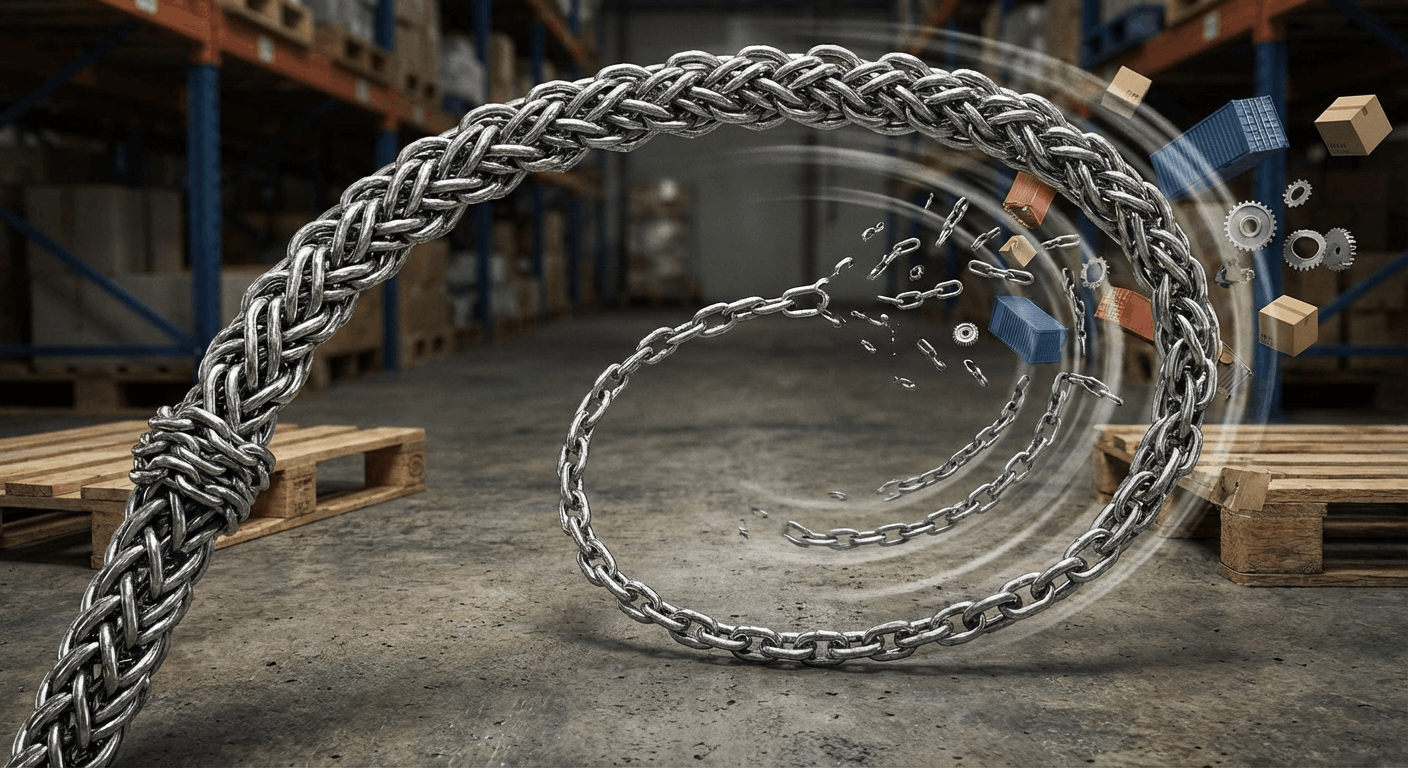
The bullwhip effect describes a phenomenon in which relatively small fluctuations in end-customer demand become increasingly amplified as one moves upstream through the supply chain – from retailer to wholesaler, manufacturer, and ultimately raw material suppliers.
Classic cases show stable retail demand translating into escalating swings in upstream orders, resulting in inventory imbalances, inefficient capacity use, missed delivery windows, expedited shipping costs, and degraded customer service.
Empirical research confirms the effect: studies of thousands of firms show that upstream order variability often far exceeds downstream demand variability. Key drivers include demand-forecasting errors, order batching, price fluctuations, rationing and gaming behavior, and long lead times.
Case Studies & Illustrations
Procter & Gamble (P&G)
P&G famously observed that while retail diaper demand was relatively stable, distributor and supplier orders fluctuated dramatically. The company mitigated this by improving information sharing and adjusting order-cycle policies to reduce overreaction.
Infineon Technologies (Semiconductors)
Simulation models of Infineon’s multi-tier semiconductor supply chain showed how modest demand changes triggered large upstream swings due to internal decision rules. The result was excess inventory, underutilized capacity, and overreaction to transient spikes.
COVID-19 Pandemic Shock
Research during the pandemic found significant amplification of the bullwhip effect across U.S. industries. Long lead times, low tier visibility, and transportation bottlenecks turned manageable fluctuations into severe volatility.
Why the Bullwhip Effect Matters for Aerospace & Defense
The A&D sector is especially vulnerable due to its complex, multi-tier supply chains, long lead times, and reliance on custom or single-source components.
- Deep supplier tiers: visibility decreases rapidly upstream.
- Mission-critical stakes: delays affect readiness and national security.
- Long lead times: capacity cannot be ramped quickly.
- Geopolitical exposure: foreign sourcing amplifies risk.
- Planning mismatches: coarse downstream signals trigger exaggerated upstream responses.
These conditions make A&D supply chains fertile ground for embedded bullwhip dynamics that surface only when costs and schedules are already compromised.
Prevention & Mitigation Strategies
To counteract the bullwhip effect, A&D supply-chain professionals can apply the following strategies:
- Increase visibility and information sharing: share real demand data and forecasts across tiers.
- Shorten lead times and reduce order batching: favor smaller, more frequent orders and modular designs.
- Stabilize pricing and allocation policies: avoid panic ordering and gaming behavior.
- Supplier diversification and tier mapping: identify bottlenecks and pre-qualify alternatives.
- Design for flexibility: use modular components and common parts where possible.
- Expand performance metrics: track variability, responsiveness, and upstream risk indicators.
- Scenario planning and stress testing: simulate demand and disruption scenarios to pre-position mitigations.
The Shift from Efficiency to Resilience
The bullwhip effect demonstrates that supply chains are dynamic systems, not linear pipelines. In Aerospace & Defense, where disruption costs are extreme, supply chains optimized purely for efficiency are increasingly fragile.
The emerging paradigm emphasizes just-in-case thinking: shorter, more transparent, flexible, and regionally diversified supply networks.
By recognizing the drivers of the bullwhip effect, A&D professionals can move from reactive problem-solving to proactive risk management – identifying where the next upstream surge or bottleneck may occur and mitigating it before it impacts mission success.